Good Halloween coloring pages for homeschool do more than fill a quiet corner of the day. They give children a friendly way to explore seasonal vocabulary, practice hand control, notice shapes and patterns, tell stories, and make something personal. The activity can be as simple as coloring one pumpkin beside a cup of tea, or as rich as building a complete Halloween mini-unit around art, reading, math, science, and writing.
The key is flexibility. Homeschool families rarely have identical schedules or identical learners. One child may want a simple page with a big friendly ghost; another may prefer a detailed haunted house. Some days call for a structured worksheet, while other days need a low-pressure creative break. A good collection of Halloween pages can support all of these moments without turning every picture into a test.
This guide explains how to choose pages, adapt them for different ages, and build useful activities around them while keeping the spirit of coloring intact.
Why coloring works well in a homeschool day
Coloring is easy to begin and easy to stop. That makes it useful between larger lessons, during a transition, or on a day when attention is limited. A page gives the learner a defined surface and a clear starting point without requiring a blank sheet of paper.
It also creates a natural place for conversation. While a child colors, you can talk about the objects in the scene, ask what might happen next, or notice how one color changes the feeling of the picture. The conversation does not need to become a formal lesson. Sometimes a child’s explanation of why the moon is green is the most interesting part of the activity.
- It supports pencil and hand control without feeling like drills.
- It gives early learners a reason to name colors, shapes, and objects.
- It offers older children a visual prompt for stories and descriptions.
- It can become a shared activity for siblings at different levels.
- It provides screen-free creative time with very little preparation.
Our age-by-age Halloween coloring guide can help you choose a page that matches the learner’s current control, attention span, and comfort with spooky imagery.
Choose the right page for the learner
Start with the learner rather than the worksheet category. A page labeled “preschool” may still be too busy for a child who prefers one large shape, while an older child may enjoy an easy page as a way to relax. Look for the right combination of open space, line weight, subject, and challenge.
| Learner | Look for | Possible extension |
|---|---|---|
| Toddler | One friendly object, thick lines, large areas | Name, point, and choose colors |
| Preschool | Two or three subjects, simple scenes | Count shapes or tell a short story |
| Kindergarten | Letters, numbers, color keys, clear outlines | Trace, read, sort, or compare |
| Elementary | Scenes, puzzles, patterns, smaller details | Write, research, measure, or design |
| Older learner | Atmospheric art, mandalas, detailed illustrations | Study palette, composition, or style |
For younger children, begin with preschool and toddler pages. For a more detailed page, offer a witch’s cottage, pumpkin landscape, or moonlit scene. A mixed-age homeschool table works best when everyone can choose from two or three levels.
Literacy activities with Halloween coloring pages
Seasonal art gives early literacy a concrete subject. A child can see a bat, say the word, listen for its first sound, and then color it. An older learner can use the same illustration to write a paragraph or compare descriptive words.
Vocabulary and picture-word matching
Choose five words from the page: pumpkin, witch, cat, moon, leaf, broom, cottage, or ghost. Say each word, clap the syllables, and ask the child to find the object in the picture. For a beginning reader, write the words on small cards and match them to the illustration.
Our Halloween vocabulary coloring guide includes ideas for word recognition, tracing, speaking, and seasonal English practice.
Alphabet and phonics
Use one letter per page or select a few target sounds. “B” can lead to bat, broom, and black cat. “P” can lead to pumpkin, potion, and porch. The child can color the picture, circle the initial letter, and draw another object that begins with the same sound.
For a ready-made starting point, explore Halloween alphabet coloring pages.
Story starters
Ask one open question: Where is the witch going? Why is the cat watching the window? What happened before the pumpkin lit up? Older children can write three sentences, a diary entry, a comic caption, or a short description using five sensory words.
See Halloween coloring pages with writing prompts for more ways to connect illustration and composition.
Math activities that begin with a picture
A coloring page can turn abstract math into something visible without becoming a full worksheet. Keep the question connected to the image and stop before the activity feels crowded.
- Count pumpkins, stars, leaves, windows, or bats.
- Sort objects by size, shape, color, or position.
- Find and color all the circles, triangles, or rectangles.
- Create a repeating pattern with pumpkin, leaf, pumpkin, leaf.
- Compare which pumpkin is taller, wider, or closer.
- Estimate how many sections a large shape contains, then check.
- Use a color key for simple addition or subtraction mystery pictures.
For younger learners, color-by-shape worksheets provide a clear connection between directions and picture. For early reading and number recognition together, try color-by-sight-word pages.
Fine-motor practice without pressure
Coloring naturally invites the hand to move in controlled ways, but it should not be treated as a performance test. The child can use broad strokes, short strokes, circular motions, or a combination. Choose tools that fit the hand and let the picture absorb the practice.
Crayons are useful for broad movement. Short colored pencils invite a more controlled grip. Washable markers create strong feedback but may move quickly across the page. Dot markers help younger children fill large spaces without requiring a precise tip.
- Offer one page with large areas.
- Let the learner choose between two tools.
- Encourage a comfortable grip rather than a perfect one.
- Invite short breaks before the hand becomes tired.
- Celebrate choices and persistence, not staying perfectly inside every line.
Our guide to Halloween coloring for fine-motor skills includes tracing, cutting, and hand-eye coordination ideas that can follow a coloring session.
Science and nature connections
Halloween imagery can open the door to simple nature study. A pumpkin page can lead to the life cycle of a pumpkin, seed saving, or a discussion of how plants grow. A bat page can introduce nocturnal animals, echolocation, and local habitats. Leaves and harvest scenes can begin a conversation about seasonal change.
Keep the science accurate but accessible. After coloring a bat, look up one fact together. After coloring a moon, discuss what changes and what does not. After coloring a pumpkin, cut one open if you have one available and compare the real seeds to the illustration.
The coloring page is a visual anchor, not the whole lesson. It gives younger learners a subject to notice and older learners a reason to ask a question.
Social-emotional learning and calm transitions
Homeschool days include moments when the next activity is not ready, energy is high, or a learner needs a reset. A short coloring page can provide a calm transition without being presented as a punishment or a demand to “calm down.”
Choose a friendly ghost, a pumpkin, a cat, or a cozy cottage. Ask how the character might be feeling, what helps them feel safe, or what they would do next. A child can color a “calm color,” a “brave color,” or a color that matches their current mood. There are no required answers.
For more structured ideas, see Halloween calm corner coloring pages and Halloween affirmation coloring pages. Use these as optional tools, not as a replacement for listening to the child.
Build a one-week Halloween homeschool mini-unit
A single illustration can support several short lessons across a week. The structure below is intentionally light so it can fit around your usual curriculum.
- Monday — observe and color: choose a page, name the objects, and make a first color plan.
- Tuesday — vocabulary: select five words, practice sounds or definitions, and label the picture.
- Wednesday — math: count, sort, compare, or create a pattern from the illustration.
- Thursday — story: write or dictate what is happening before and after the scene.
- Friday — make and share: finish the page, display it, cut it into a card, or explain the choices.
You do not need to use every day. The value is in seeing how one page can become more than a one-time worksheet. A single pumpkin can support art, vocabulary, measurement, narrative, and family conversation.
Use a printable activity book instead of loose pages
Some learners enjoy choosing from a stack; others work better when the pages feel like a book. You can print a small packet, add a cover, and staple or bind it. Include a mix of coloring pages, puzzles, tracing, drawing, and reflection so the learner can choose the right kind of activity for the moment.
Our guide to a Halloween activity book printable shows how to combine coloring with mazes, word searches, I Spy, drawing, and seasonal games. For a shorter packet, see free Halloween activity sheets.
Print single-sided if the learner will use markers or if you want to remove finished pages. Use thicker paper for display pieces and ordinary paper for practice sheets. Check the PDF page size before printing; our printable PDF guide covers scaling and margins.
Make the activity inclusive and flexible
Homeschool learners can have different sensory preferences, motor abilities, reading levels, and feelings about Halloween. A flexible setup makes participation easier.
- Offer bold, low-detail pages alongside detailed scenes.
- Let a child color digitally, use a larger tool, or dictate a story.
- Use friendly imagery when spooky content feels too intense.
- Allow the page to remain unfinished.
- Provide a quiet option without requiring conversation.
- Let siblings work on different pages within the same theme.
Our sensory-friendly Halloween coloring guide includes ideas for predictable layouts, gentle subjects, and lower-stimulation choices.
Supplies for a low-prep homeschool table
You do not need a special art cart. Keep a small basket with copy paper or cardstock, chunky crayons, washable markers, colored pencils, an eraser, a pencil sharpener, and a backing sheet. Add scissors and glue only when the planned activity includes a craft.
Test wet markers on the actual paper before printing a whole packet. Alcohol markers can bleed through thin pages; water-based markers may still show through after repeated passes. Colored pencils are often the most forgiving choice for detailed printable pages. Our articles on markers and colored pencils explain the trade-offs in more detail.
For toddlers, supervise small caps and broken crayons. For older children, invite them to organize the supplies and return tools when the session is finished. Even cleanup can become part of the routine without becoming a formal chore lesson.
Printable pages or a digital coloring app?
Printable coloring works especially well for homeschool because it can be shared, displayed, cut, folded, and revisited. A digital app works well for travel, short breaks, and adults or older children who want undo and easy palette changes.
Use the format that matches the goal. If you are practicing cutting or making a card, print. If the learner is tired but still wants a creative choice, a digital page may reduce setup. For a comparison of formats, read online, printable, or app-based Halloween coloring.
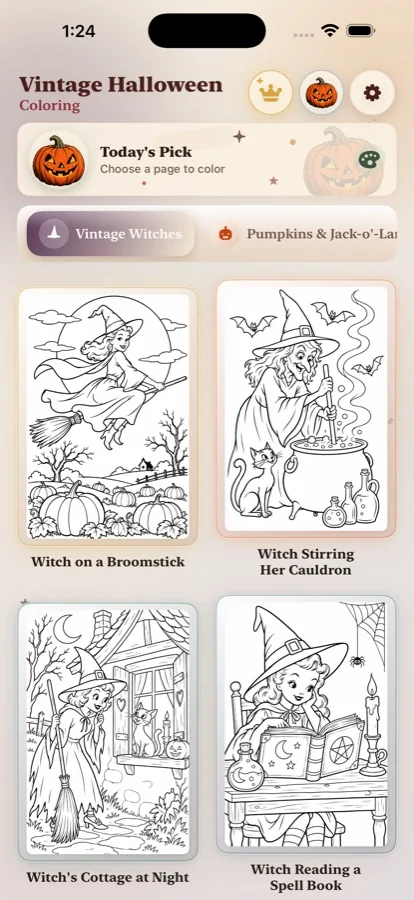
Adults can also use Vintage Halloween Coloring for iPhone while children work on paper. The same seasonal theme can support independent activities at different ages.
Keep homeschool coloring low-pressure
The best extension is the one that leaves the child wanting to return. If the page becomes crowded with instructions, remove some. If the learner wants to color the sky pink, let the sky be pink. If the child only colors one corner, that corner may be the part that mattered today.
Use questions instead of corrections. Ask, “What made you choose that color?” rather than “Is that supposed to be black?” Say, “Tell me about this house,” instead of turning every detail into a vocabulary quiz. The page can support learning without losing its pleasure.
For adults in the household, a shared coloring pause can be valuable too. Our guides to Halloween coloring for stress relief and quiet autumn coloring evenings offer ideas for making room for creative rest.
A simple homeschool checklist
Before starting, ask:
- Does this page match the learner’s current ability and interest?
- Is the Halloween imagery comfortable and welcoming?
- Do we have a tool that suits the paper?
- Is the extension optional rather than another demand?
- Could this page support one small literacy, math, science, or story idea?
- Where will the finished page go?
If you can answer these questions, you are ready. The plan can take five minutes or an entire week. The page can be a lesson, a break, a craft, or just a page.
Let the page serve the child
Halloween coloring pages for homeschool are most useful when they leave room for the learner’s own pace. A toddler can explore a pumpkin. A preschooler can name the colors. An early reader can label a cat. An older child can write a story about a haunted house. An adult can color a vintage witch while the rest of the table works nearby.
Choose artwork that invites rather than overwhelms. Add one small connection to the day’s learning, then let the creative part breathe. That balance is what makes seasonal coloring so useful: it can be purposeful without feeling over-planned.
Vintage Halloween Coloring is made around that warm, nostalgic feeling. Download the iPhone app from the official App Store page for a portable coloring break, or continue exploring our printable guides for different ages, classroom-style activities, and adult coloring ideas.
Frequently asked questions
How can I use Halloween coloring pages for homeschool?
Use a page as a short art lesson, vocabulary prompt, writing starter, counting activity, fine-motor practice, calm transition, or screen-free choice.
What ages can use them?
Toddlers and preschoolers can use bold, simple pages, while kindergarten and elementary learners can add literacy, math, science, writing, and creative projects.
Do homeschool coloring pages need to be educational?
No. Coloring can simply be art and rest. A seasonal page is valuable as a low-pressure creative break even without a worksheet objective.
What supplies are best?
Use chunky crayons for little hands, washable markers for simple pages, colored pencils for detail, and a backing sheet whenever markers may bleed.