Searching for Halloween coloring pages by age is really a search for the right level of invitation. A toddler needs a page that is easy to see and easy to hold onto. A preschooler may be ready for two or three objects in one scene. A school-age child may want a story, a puzzle, or a page filled with details. A teen or adult may prefer a gothic house, a vintage witch, or a patterned mandala that takes an entire evening.
Age ranges are useful, but they are not strict rules. Children develop at different speeds, and a page that feels perfect one week may feel too easy or too busy the next. The best approach is to look at outline weight, open space, subject matter, attention span, and emotional comfort together.
This guide maps the main choices from toddlers to adults and shows how to create a shared Halloween coloring table where everyone can participate without needing the same picture.
How to match a Halloween coloring page to a colorist
Before choosing a PDF or printable sheet, consider four questions:
- How much hand control is available? Small spaces and thin outlines require more precise movement.
- How long will the session last? A single large object works for a ten-minute activity; a detailed scene suits a longer project.
- How does the person feel about Halloween imagery? Friendly pumpkins and cats are a better starting point than skeletons or intense haunted scenes for a sensitive child.
- What tools will be used? Crayons need broad areas, fine markers need clear closed shapes, and pencils can handle more detail.
Good collections make the choice visible. Labels such as “easy,” “medium,” “detailed,” or “ages 3–5” are useful when they describe the actual design. A page should not be called easy simply because the subject is a pumpkin if the pumpkin is surrounded by dozens of tiny patterns.
Halloween coloring pages for toddlers: ages 2–3
Toddlers usually need one large, recognizable object with plenty of open space. A round pumpkin, smiling ghost, candy corn, cat, bat, or witch hat can fill the page without a busy background. Extra-thick outlines help the image remain visible when a child uses broad crayon strokes or moves outside the shape.
At this age, the goal is exploration rather than staying inside the lines. One color over the whole pumpkin is a successful result. A child may choose unusual colors, scribble across the page, or switch tools after thirty seconds. That is part of the activity.
Good toddler themes
- one friendly pumpkin or jack-o-lantern;
- a smiling ghost with a simple face;
- a large black cat or round bat;
- candy, candy corn, or a witch hat;
- big autumn leaves and simple shapes.
Choose washable crayons, chunky markers, or dot markers, and supervise small supplies. Our guide to Halloween coloring pages for preschoolers and toddlers includes more ideas for large shapes and gentle first Halloween activities.
Halloween coloring pages for preschoolers: ages 3–5
Preschoolers can often manage a page with a few separate shapes and a simple scene. They may enjoy a witch with a broom, a pumpkin beside leaves, a cat under a moon, or a group of friendly ghosts. The outlines can be slightly thinner than toddler pages, but the spaces should remain large enough for crayons and washable markers.
Preschool is also a good age to introduce the vocabulary of Halloween without pressure. Name the object, notice its shape, and let the child choose the color. A black cat does not have to be black, and a ghost does not have to be white. Creative choices are a way to make an unfamiliar holiday feel more approachable.
Helpful preschool prompts
- “Which shape is the biggest?”
- “Can you find three circles?”
- “What color should the window glow?”
- “Would your witch like a purple hat or a green hat?”
Keep the prompt optional. The page should not become a worksheet unless the child enjoys that structure. For fine-motor ideas, visit our guide to Halloween coloring pages for preschool skills.
Halloween coloring pages for kindergarten and early elementary: ages 5–7
Children in kindergarten and the early elementary years are often ready for more objects, simple backgrounds, and pages with a small narrative. They may want to color a trick-or-treat scene, a witch’s cottage, a pumpkin patch, or a group of animals in costumes. The page can include more detail as long as the main subject remains easy to identify.
This age is ideal for combining coloring with early learning. A Halloween alphabet page, color-by-shape activity, or simple word search can add structure without taking away the creative part. Use the finished art to practice describing colors, writing a sentence, or naming what happens first, next, and last.
Try Halloween alphabet coloring pages for letter recognition, color-by-shape worksheets for simple directions, or color-by-sight-word pages for a reading connection.
Halloween coloring pages for older kids: ages 7–10
Older elementary children can usually handle a full scene with background layers, smaller objects, and a clearer story. They may enjoy haunted houses, potion tables, decorated porches, costumes, monsters, bats, and trick-or-treat streets. At this age, the best page often gives them something to discover after the first obvious shapes are colored.
Offer both guided and open-ended pages. A color-by-number sheet gives a child a clear starting point, while a detailed scene allows more ownership. A hidden-picture or I Spy page adds a goal for children who like searching as much as coloring.
- Use a scene page for storytelling.
- Use a word search or maze for a quiet challenge.
- Use a collaborative poster when several children are coloring together.
- Use a drawing prompt when the child wants to add a monster, pet, or new background.
Our guides to Halloween I Spy pages, Halloween drawing prompts, and collaborative coloring posters can turn a single printable into a longer activity.
Halloween coloring pages for tweens and teens
Tweens and teens may want artwork that feels less like a preschool worksheet and more like an illustration they would choose for themselves. Look for expressive characters, gothic architecture, fashion, animals, moon phases, decorative lettering, fantasy scenes, and more intricate patterns.
“Age-appropriate” does not have to mean frightening. A vintage witch, black cat, haunted library, or autumn village can feel mature because of the composition and detail rather than graphic content. Let older children choose their own difficulty and subject whenever possible.
For this group, the color palette can become part of the creative challenge. Ask them to try a limited midnight palette, a faded vintage palette, or an unexpected combination such as teal, rust, cream, and plum. Our article on Halloween coloring pages for teens and adults offers ideas for a more grown-up mood.
Halloween coloring pages for adults
Adults often choose pages for atmosphere, concentration, nostalgia, or a quiet break from screens. Detailed witches, harvest landscapes, vintage postcards, ornate mandalas, black cats, and moonlit houses all work well. The right level of detail depends on the kind of evening: a simple pumpkin can be restorative after a busy day, while an intricate scene can support a longer focused session.
Adults also tend to care about paper, tool choice, and the finished page. Use the advice in our guides to free Halloween coloring pages for adults, colored pencils, and markers and bleed-through when preparing a printable session.
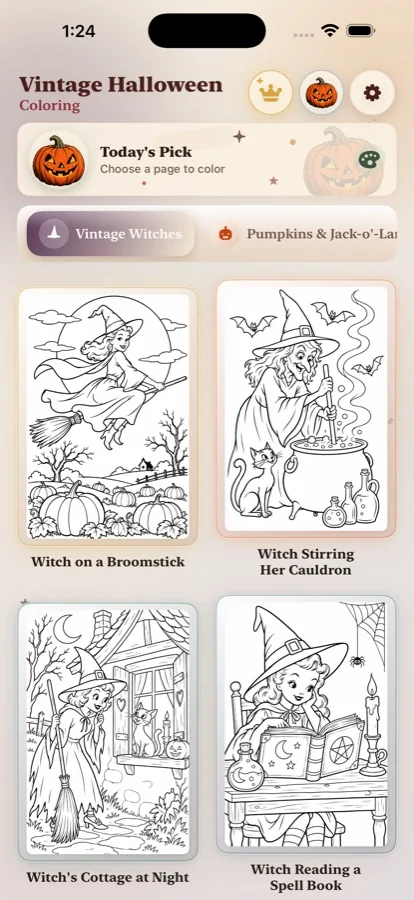
If you prefer a portable experience, Vintage Halloween Coloring for iPhone offers a digital alternative with witches, pumpkins, cats, ghosts, and nostalgic scenes. Adults can color for a few minutes or return to a page over several evenings.
How to make one Halloween theme work for every age
A shared theme is often better than forcing everyone to use the same difficulty. Choose “pumpkins,” “witches,” “black cats,” or “moonlight,” then offer different page types around that theme.
| Age group | Page style | Tools | Optional extension |
|---|---|---|---|
| Toddlers | One large friendly shape | Chunky crayons or dot markers | Name the object and color |
| Preschool | Two or three simple subjects | Crayons or washable markers | Count shapes or tell a story |
| Early elementary | Simple scene or guided page | Colored pencils or fine markers | Letters, words, or color key |
| Older kids | Detailed scene or puzzle page | Pencils, markers, or gel pens | Writing prompt or hidden picture |
| Teens and adults | Atmospheric illustration or pattern | Layered pencils, markers, or app | Palette study or finished display |
This setup works at a family table, a classroom party, a library program, or a quiet afternoon at home. Everyone belongs to the same seasonal world, but nobody has to prove anything by finishing the hardest page.
How to make Halloween coloring less scary
Some children love spooky imagery immediately. Others need a gentler introduction, especially if Halloween costumes, decorations, or neighborhood displays already feel intense. A coloring page gives them control, which can help: they can choose the subject, the colors, and when to stop.
- Begin with pumpkins, leaves, cats, candy, or friendly ghosts.
- Choose smiling or neutral faces instead of threatening expressions.
- Avoid graphic imagery and let the child decide when to try darker themes.
- Use bright or surprising colors to make a page feel playful.
- Keep a non-Halloween autumn page nearby as an alternative.
Never insist that a child color a page that makes them uncomfortable. A pink bat or a blue ghost is not “wrong”; it is a way of taking ownership. Our kawaii Halloween coloring guide is a good place to start when the mood should be cute rather than creepy.
Choose supplies by age and page size
For toddlers and preschoolers, chunky crayons, washable markers, and dot markers are easier to grip. For early elementary children, standard crayons, colored pencils, and fine washable markers offer more control. Older children and adults can experiment with gel pens, brush markers, layered pencils, or digital tools.
Match the tool to the paper. Broad wet markers can bleed through thin pages, so put a backing sheet underneath and test first. Colored pencils are versatile for detailed pages. If printing for a group, use a paper that feeds reliably and consider single-sided pages so finished artwork can be displayed.
For printing advice, see our printable PDF guide. If you are creating a craft with the finished pages, the article on Halloween coloring page crafts includes ideas for garlands, cards, and decorations.
Turn age-appropriate pages into meaningful activities
Coloring can remain a quiet creative activity, or it can become a doorway into conversation and learning. Keep the extension short and optional. One question can be enough.
- Language: describe the setting, character, texture, or color.
- Math: count pumpkins, compare sizes, or find repeated shapes.
- Storytelling: decide where the witch is going or who lives in the house.
- Social-emotional learning: name how a character might feel and what would help them.
- Craft: cut out a finished pumpkin, card, mask, or bookmark.
For classroom use, set up a choice board with easy, medium, and detailed pages rather than assigning one sheet to everyone. A child who finishes early can move to a puzzle or writing prompt, while another child can continue coloring without feeling behind. Our guide to Halloween coloring pages for the classroom covers centers, early finishers, and seasonal group activities.
Printable pages or a digital app?
Printable pages are easy to share and turn into physical keepsakes. They suit family tables, classrooms, parties, crafts, and situations where several people want to color together. A digital app is portable, tidy, and flexible when you want undo, palette changes, or a short activity away from a printer.
Adults and older children may enjoy a Halloween coloring app for iPhone, while younger children often benefit from the physical scale and sensory feedback of paper. There is no reason a family cannot use both: a child can color a printable pumpkin while an adult explores a digital witch scene.
The best format is the one that removes friction. If getting started requires too much setup, choose the simpler option. A five-minute coloring moment still counts.
Quick checklist for choosing the right page
Before printing a large pack, use this short checklist:
- Does the detail match the colorist’s current hand control?
- Are the characters friendly enough for the intended audience?
- Will the page fit the chosen crayons, pencils, or markers?
- Is there enough open space for the session length?
- Can the person choose between two or three themes?
- Does the PDF print clearly at the intended paper size?
- Is there an easier alternative nearby if the page feels wrong?
When the answer to most of these questions is yes, the page is likely to feel inviting. If the activity still does not work, change the page before changing the child. Difficulty is a design problem, not a personal failure.
Let every age have its own kind of Halloween
The best Halloween coloring pages by age do not create a ladder where one group is “better” because its pages are more detailed. They create different doors into the same season. A toddler discovers a pumpkin’s shape. A preschooler gives a ghost a new color. A school-age child invents a story. A teen builds a dramatic palette. An adult settles into a vintage scene after a long day.
Choose the page that makes the colorist want to pick up a tool. Keep the activity flexible, let the mood stay friendly, and offer enough variety that everyone can find a comfortable starting point.
Vintage Halloween Coloring brings that seasonal world to adults and older colorists through nostalgic illustrations and a dedicated iPhone app. Download the app from the official App Store page, or continue exploring our printable guides for little hands, teens and adults, and creative autumn ideas.
Frequently asked questions
How do I choose Halloween coloring pages by age?
Look at hand control, attention span, comfort with Halloween imagery, and interest level. Younger children need open shapes and bold outlines; older colorists can enjoy layered scenes and finer detail.
What pages are best for toddlers?
Choose one large friendly subject per page, very bold outlines, minimal background detail, and familiar objects such as pumpkins, ghosts, cats, bats, and candy.
How can I make Halloween coloring less scary?
Start with friendly characters and autumn objects, let the child choose the page and colors, and avoid graphic or intense imagery until they are ready.
Can adults and children color together?
Yes. Offer pages at different difficulty levels around the same theme so everyone can participate without using the same design.