
Halloween is full of memorable objects: a round pumpkin, a black cat, a bright moon, a crooked witch hat, a friendly ghost, and a broom flying across the sky. That makes the season a natural setting for Halloween vocabulary coloring pages. A learner can see the word, hear it, trace it, point to the matching picture, and then color the scene. The activity is simple, but the combination of image, sound, movement, and personal choice gives the vocabulary more than one way to stay in memory.
This guide is for ESL and EFL teachers, homeschool families, parents, librarians, and anyone planning an easy English activity for October. It is also useful for adult beginners who prefer a relaxed visual warm-up instead of a dense worksheet. The goal is not to turn a creative page into a test. The goal is to give a new word a pleasant context.
Why coloring can support Halloween English vocabulary
New vocabulary is easier to approach when the learner has a clear reference. A labeled illustration makes the meaning visible. The learner does not have to translate every word before beginning; they can look at the pumpkin, read pumpkin, hear the teacher or parent say it, and connect the sound to the shape. Coloring then adds a quiet period of repetition.
That does not mean coloring alone guarantees language learning. It works best as one part of a short sequence: introduce a small word set, model the pronunciation, let learners interact with the image, and revisit the words in a game or sentence. Keep the pressure low, especially for children who are still building confidence in English.
- Visual meaning: the object and the written word appear together.
- Pronunciation: the teacher, parent, or audio model supplies the sound.
- Recognition: learners find the same word in a list, label, or matching task.
- Personal connection: color choices make the page feel like the learner's own picture.
- Repetition without monotony: the same vocabulary can return through coloring, pointing, drawing, and conversation.
Start with a small Halloween word bank
A common mistake is introducing too many seasonal words at once. Begin with six to ten concrete nouns. The first set should be easy to illustrate and easy to point to. For a beginner lesson, try pumpkin, ghost, cat, bat, witch, hat, moon, candy, spider, and web. A slightly more advanced group could add broom, lantern, costume, haunted house, skeleton, and jack-o'-lantern.
Sort the words by what learners can do with them. Nouns are a comfortable starting point because they map directly to objects. Then add a few colors or actions: orange, black, purple, fly, glow, knock, and hide. The sentence “The black cat is under the moon” is more useful after learners already know cat, moon, and black.
Five ways to use vocabulary coloring pages
1. See, say, and color
Show one page with a large picture and its label. Say the word naturally, then invite learners to repeat it once or twice. Ask them to point to the picture before they begin coloring. During the activity, return to the word casually: “What is this?” “What color is your pumpkin?” “Can you find the bat?” The page becomes a visual anchor for a short, friendly conversation.
2. Label the picture
Use a page with several objects and a small word bank. Younger learners can match printed labels to the correct pictures. Older learners can write the words themselves. To reduce the difficulty, provide the first letter or dotted tracing lines. To increase it, remove the word bank and ask learners to label three objects from memory.
3. Add a color-and-word challenge
Color instructions can create a natural listening task: “Color the pumpkin orange. Make the moon yellow. Give the cat a purple bow.” Keep the instructions short and demonstrate the first one. Avoid making the activity dependent on one correct artistic result; the language practice is in understanding the instruction and choosing how to finish the picture.
4. Build a sentence from the finished page
After coloring, offer a sentence frame. Beginners might complete “I see a ___.” or “The ___ is ___.” More confident learners can try “The friendly ghost is flying over the old house.” A drawing can become a speaking prompt, a caption, or three lines of creative writing. This connects the word list to meaning rather than keeping vocabulary isolated on the page.
5. Play a picture-word hunt
Place several completed or partly colored pages on a table. Call out one word and let learners find the matching image. Reverse the game by pointing to a picture and asking for the word. For a pair activity, one learner describes a color or location while the other points: “Find the orange pumpkin,” “Point to the spider web,” or “Where is the moon?” This works well as a quick review at the end of a lesson.
Adapt the activity for different ages and levels
For preschool and kindergarten learners, choose one large object per page, bold outlines, and a short oral routine. Say the word, point to the picture, trace the first letter, and let the child color. Our guide to Halloween coloring pages for preschoolers and toddlers has more ideas for open shapes, friendly subjects, and manageable prompts.
For elementary ESL learners, use a page with four to eight labeled objects. Add matching, a simple word search, count-and-say prompts, or a “find something orange” challenge. Students can write one sentence about the picture or create a tiny Halloween caption. The broader Halloween classroom coloring guide explains how to place this kind of activity in centers, early-finisher folders, and seasonal lessons.
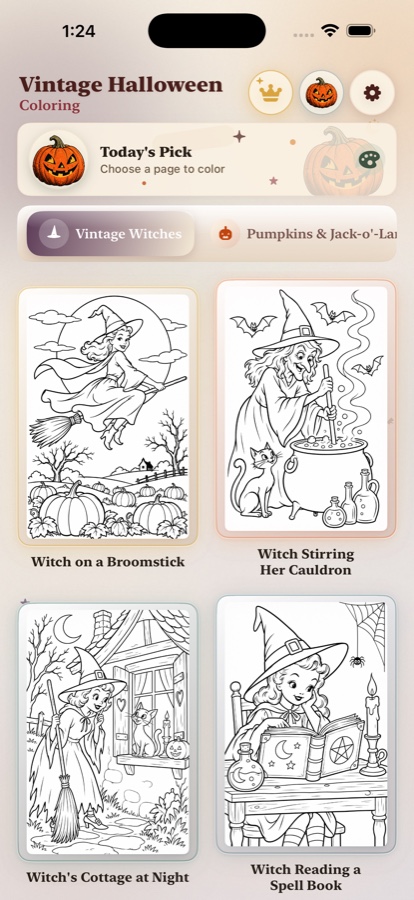
For teens and adults, make the vocabulary less childish by choosing vintage illustrations, atmospheric scenes, or a limited palette. Ask learners to describe mood, setting, texture, and character. A page can introduce words such as flicker, shadow, harvest, crooked, mysterious, and lantern before a short reading or conversation. If the goal is a calmer adult activity, pair it with the suggestions in our guide to Halloween mindfulness coloring pages for adults.
Make a printable ESL lesson from one page
A 20- to 30-minute lesson does not need a complicated worksheet pack. Pick one illustration and plan four small stages:
- Warm-up: show three to six picture cards or point to objects in the illustration.
- Model: say each word, clap its syllables when useful, and let learners repeat without pressure.
- Color and label: let students choose their tools, then match or write the words.
- Share: invite a sentence, a favorite color, or one “I can see…” observation.
For a longer class, add a second round with a new word set. For a shorter session, skip writing and keep the activity oral. A small, repeatable routine is easier to remember than a crowded page of instructions.
Printable pages are especially convenient because they work at a table, in a reading corner, during indoor recess, or as a take-home activity. Check the paper size before printing, use a test page, and choose tools that fit the group. Our practical guide to Halloween coloring pages in printable PDF format covers print settings, paper, and page selection.
Keep the language activity welcoming
Language learners make mistakes in public all the time. Coloring gives them a little more space. Let a learner point before speaking, use the word bank, or answer with one word before asking for a sentence. Pronunciation can be modeled again without embarrassment. If a child wants to color outside the expected palette, let them; “a purple pumpkin” can become a useful conversation rather than a correction.
Be thoughtful with Halloween imagery, too. Some learners may enjoy witches, ghosts, and haunted houses; others may prefer pumpkins, cats, moonlight, or autumn leaves. Offer a choice. A friendly, culturally responsive activity makes it easier for everyone to participate, especially in a mixed group.
For learners who benefit from a quieter option, place the pages in a calm area and remove the requirement to finish. Our article on Halloween calm corner coloring pages offers a non-clinical approach to choice, feelings vocabulary, and low-pressure creative pauses.
From one Halloween word to a small story
The best vocabulary activities leave room for imagination. Start with pumpkin. Add lantern, path, cat, and moon. Suddenly learners can describe a scene: “The cat is walking on the path. The lantern is beside the pumpkin. The moon is bright.” The coloring page has become a tiny story map.
That is the lasting value of Halloween vocabulary coloring pages. They are not only printable pictures and they are not only flashcards. They are a gentle bridge between a new English word and something the learner can see, touch, color, describe, and remember. Begin with a few familiar objects, keep the prompts human, and let the finished page carry the conversation.
Frequently asked questions
What are Halloween vocabulary coloring pages?
They combine a Halloween illustration with a written English word or small word bank. Learners can color while recognizing, tracing, saying, matching, or using the word in a simple sentence.
Which Halloween words are best for beginner English learners?
Start with concrete words such as pumpkin, ghost, cat, bat, witch, hat, moon, candy, spider, and web. Add longer words gradually.
How can I use Halloween coloring pages in an ESL class?
Preview the vocabulary, model pronunciation, let learners color and label the picture, then use matching, pointing, pair questions, or a short sentence frame.
Can adults use Halloween vocabulary coloring pages?
Yes. Adult beginners can use them for low-pressure vocabulary review, pronunciation practice, journaling, or a visual warm-up before a Halloween conversation lesson.