Halloween coloring pages can do more in a classroom than fill a few spare minutes. The right page creates a quiet point of focus, gives students a low-pressure way to make something, and brings a seasonal mood into the room without requiring a complicated craft setup. For teachers, the most useful collection is not necessarily the one with the loudest characters or the most frightening scenes. It is the one that is easy to print, flexible for different ages, and open enough for every student to make a personal choice.
A thoughtful set of printable Halloween coloring pages can support morning work, early finishers, literacy centers, library tables, indoor recess, art lessons, and a Halloween classroom party. With a few small prompts, the same illustration can become a vocabulary exercise, a writing starter, a color-theory challenge, or simply a peaceful creative break.
What makes a good Halloween coloring page for a classroom?
Classroom materials need to work for a group, not only for one ideal student. A page should be visually clear when printed in black and white, simple enough to understand without a long explanation, and interesting enough to hold attention for more than a few minutes. It should also leave room for different approaches: some students will carefully shade every detail, while others will use bold colors and finish quickly.
Look for pages with:
- Clean outlines: strong line art remains readable on an ordinary classroom printer and does not disappear when a student uses crayons.
- Several levels of detail: open shapes help a student who wants a quick win, while layered scenes give an experienced colorist a longer project.
- Seasonal variety: witches, pumpkins, bats, cats, ghosts, harvest fields, and haunted houses offer different entry points.
- A welcoming mood: cozy or gently spooky artwork works better for a mixed group than images that depend on graphic horror.
- Enough white space: students need room to make choices rather than feeling that every inch must be filled.
Our Halloween coloring pages collection is built around vintage witches, pumpkin fields, black cats, moonlit trees, and storybook scenes. The pages feel seasonal without forcing one specific style of Halloween.
Five classroom uses for printable Halloween coloring pages
1. A quiet morning arrival activity
Place a small selection of pages and colored pencils on a table before students arrive. A quiet visual task gives the room a softer beginning and lets students settle without needing a full lesson immediately. Use a simple sign such as “Choose one page, one palette, and one detail you want to notice.”
Morning coloring works particularly well when the pages are not all identical. Choice helps students feel that the activity belongs to them, while a shared theme gives the room a sense of coherence.
2. An early-finisher folder
Early finishers need an independent option that is genuinely worthwhile, not a punishment for working quickly. Create a folder with easy, medium, and detailed Halloween coloring pages. Add a few blank backs or sketch prompts so students can extend the idea when they finish.
To keep the folder manageable, print a small rotating set rather than every page at once. Replace a few designs each week and invite students to suggest subjects such as a pumpkin shop, a friendly ghost, a witch's library, or a cat under a harvest moon.
3. A literacy or vocabulary center
Turn one illustration into a language activity with a short word bank. A haunted house can introduce words such as attic, chimney, shutters, path, lantern, and shadow. A witch's table can support vocabulary for objects, textures, and actions. Younger students can label objects, while older students can write a caption or a short scene.
Ask students to choose three details before they color. They might write “a crooked tree,” “one glowing window,” and “a black cat.” This simple step makes observation part of the activity and helps students slow down enough to see the composition.
4. A color-theory mini lesson
Halloween artwork makes warm and cool colors easy to demonstrate. Ask students to create two versions of the same small area: one using pumpkin orange, gold, and red, and another using midnight blue, violet, and cool gray. Discuss how the mood changes even though the line art stays the same.
You can also introduce an accent color. Tell students to choose one color that appears three times in the picture. A yellow window, a ribbon, or a moon can become a visual path through the scene. For palette inspiration, see our guide to Halloween coloring book color palettes.
5. A calm station during a Halloween party
A coloring table gives a classroom party a quieter option for students who do not want a loud game or who need a short break. Set out a mixture of familiar subjects and protect the surface with scrap paper. Pencils and crayons are usually easier to manage than wet materials when the room is busy.
Keep the instruction open-ended: “Choose a page and make the mood you want.” This respects students who want cute, spooky, vintage, bright, or almost monochrome results.
How to choose pages for different ages
Students in the same class can have very different preferences and fine-motor confidence. Rather than assigning pages by age or ability, offer a visible range and let students choose. This prevents a detailed page from becoming a test and keeps a simple page from feeling embarrassing.
- Open and easy: one pumpkin, ghost, cat, or witch hat with bold outlines and large areas.
- Balanced: a character in a setting with a few background objects, leaves, stars, windows, or costume details.
- Detailed: a full harvest landscape, haunted cottage, potion shelf, spell book, or moonlit village.
Our guide to easy Halloween coloring pages for beginners is useful when you need large shapes and a gentle starting point. For older students or longer quiet sessions, Halloween coloring pages for teens and adults offers more mature scenes with mixed difficulty.
Printable PDF tips for teachers
Before printing a whole class set, test one page on the printer you will actually use. Check that the margins are comfortable, the lines are dark enough, and the page fits the available paper. If your school uses both US Letter and A4, choose artwork with a little breathing room around the edges or select “fit to page” in the print dialog.
Print a few extras for students who make a mistake, want to try a second palette, or join the activity late. If you are using markers, place a spare sheet behind the page. If you are using colored pencils, slightly heavier paper can make the experience feel more special, but ordinary copy paper is perfectly suitable for a short center.
For a fuller checklist on paper, scale, and printer settings, read our Halloween coloring pages printable PDF guide.
Make the activity inclusive and low pressure
Not every student enjoys Halloween in the same way. Some love witches and haunted houses; others prefer pumpkins, autumn leaves, friendly ghosts, or cats. A broad set of subjects lets students participate without having to choose imagery they find uncomfortable.
It also helps to avoid language that implies there is one correct finished page. Instead of asking everyone to color the pumpkin orange, invite students to decide whether their pumpkin is traditional, moonlit, pastel, patterned, or completely imaginary. The choice becomes part of the learning.
For students who find fine detail tiring, include pages with open spaces. For students who need more challenge, offer a page with a layered scene or suggest adding a background pattern. If coloring is not the right format for someone, they can describe the scene, design a border, or write a short story based on the picture.
Simple prompts that add educational value
A good prompt should extend the page without taking away its relaxing quality. Keep it short enough to understand at a glance:
- Choose three words that describe the mood of your picture.
- Use one warm palette and one cool accent.
- Add a sign, window, or small object that tells part of a story.
- Write a five-sentence description of what happened before the scene.
- Find three repeated shapes and give each one a different color rhythm.
- Design a tiny color key for someone else to follow.
These prompts work for art, writing, vocabulary, and observation without turning every page into a worksheet. Students can complete them independently or share a favorite detail at the end of the session.
Digital coloring as a classroom extension
Printable pages are ideal for screen-free centers, but digital coloring can be useful in a supervised iPad activity or at home after school. A digital app makes it easy to test a palette, undo a choice, zoom into a small detail, and save multiple versions of the same scene.
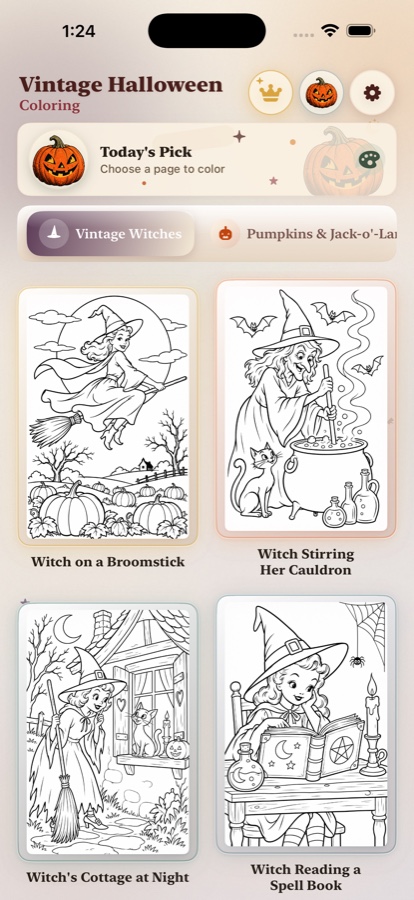
The Vintage Halloween Coloring iOS app is designed for people who enjoy nostalgic Halloween illustration and want a portable creative activity. It can complement printable pages: paper offers a tactile break, while the app offers quick experimentation and a tidy digital collection.
A ready-to-use 20-minute classroom plan
For a simple lesson, begin with two minutes of choice. Let each student select a page and notice one detail before coloring. Give ten to twelve minutes for coloring, then offer a short prompt: name the mood, identify the main accent color, or write one sentence about the scene. Finish with a quiet gallery walk or an optional partner share.
The plan is deliberately small. It does not require a craft demonstration, a special supply list, or a perfectly finished product. It gives students a beginning, a calm middle, and an easy way to reflect on what they made.
Why Halloween coloring belongs in the classroom
The best Halloween coloring pages are not just seasonal decorations. They give students a structured creative choice at a time of year that can otherwise become very noisy and overstimulating. A page offers focus without pressure, conversation without competition, and a finished object that can be displayed or taken home.
Choose clear printable artwork, provide different levels of detail, and let students decide what kind of Halloween they want to create. A witch can be mysterious, funny, elegant, or kind. A pumpkin can be orange, blue, striped, or glowing. When the page leaves room for that decision, a small coloring activity becomes a surprisingly rich classroom experience.
Frequently asked questions about classroom Halloween coloring
What Halloween coloring pages work best in a classroom?
Choose clear, printer-friendly pages with familiar subjects, moderate detail, and several difficulty levels. Witches, pumpkins, cats, bats, haunted houses, and friendly ghosts work well for seasonal classroom centers.
Can Halloween coloring pages be used for early finishers?
Yes. Keep a small folder of independent coloring pages available for students who finish early. Offer simple, medium, and detailed designs so the activity remains welcoming rather than feeling like extra work.
How do I make a Halloween coloring activity more educational?
Add a short writing, vocabulary, observation, or color-theory prompt. Students can describe a scene, label objects, create a limited palette, write a caption, or compare warm and cool colors.
Are printable Halloween coloring pages suitable for a Halloween party?
Yes. Print a variety of designs, protect tables, provide pencils or crayons, and let students choose their own page. Short, open-ended coloring stations are easy to supervise during a classroom celebration.