Scary Halloween coloring pages for adults invite a different kind of color choice. A haunted house, a skeleton under a bare tree, or a path disappearing into fog can feel eerie before you add a single shade. The coloring challenge is to keep the scene dark enough to hold its mood while preserving the outlines, focal point, and details that make it worth coloring. You can do that with a small palette, a deliberate light source, and a few carefully placed accents.
Public Halloween coloring collections often separate scary adult pages from friendly or child-focused designs, while coloring-book publishers continue to list horror-themed adult titles. That suggests a distinct audience and search intent, though it does not reveal exact keyword volume. The public results include a dedicated scary Halloween pages section for adults; Dover’s 2026 trade catalog also lists a gothic horror coloring book.
What makes a Halloween coloring page feel scary?
A frightening or suspenseful image does not need graphic details. Often the strongest clues are compositional:
- A strong silhouette: a crooked roof, an unfamiliar shape between trees, or a figure at the end of a path creates a question for the eye.
- Uneven light: one lit window in a dark house feels more charged than every window glowing equally.
- Empty space: a wide area of sky, fog, or foreground lets the viewer imagine what may be outside the frame.
- Scale: a small figure beneath a tall building or bare tree can make a familiar scene feel vulnerable.
- Unusual detail: a broken fence, tilted frame, distant bat, or open door can suggest that something has just happened—or is about to.
These visual choices separate eerie Halloween art from a merely dark palette. If the page has no clear subject, color may not make it easier to read. Start by locating the main shape and decide what the viewer should notice first.
Choose the level of scare you enjoy
“Scary” can describe several different moods. Decide where your page sits before selecting its colors:
- Spooky: bats, pumpkins, black cats, moonlight, and a little mystery.
- Eerie: empty houses, bare branches, mist, distant shapes, and quiet tension.
- Macabre: skeletons, old portraits, graveyard symbols, and a stronger sense of mortality.
- Horror-inspired: dramatic shadows, unsettling faces, and more intense imagery.
These categories are descriptive, not strict ratings. A skeleton can be playful or unsettling depending on its pose and surroundings. A haunted house can feel like a storybook adventure or a horror scene. Choose artwork that matches your preference; no image needs to become more graphic to count as Halloween.
For a dark-romantic rather than horror-forward direction, see our guide to gothic Halloween coloring pages for adults. If you prefer gentler pages, explore cute and cozy-spooky Halloween coloring.
Build a palette that keeps the scene legible
A useful scary-page palette contains several different darks, one or two midtones, and a small light source. If every shadow becomes black, the shapes merge and the line art disappears. Try separating the darkest values by hue:
- Charcoal: deep silhouettes, roof edges, branches, and the darkest corners.
- Indigo or blue-gray: night sky, distant buildings, and cool shadows.
- Muted violet or forest green: secondary darks for clothing, leaves, or stone.
- Bone cream or pale gray: fog, moonlight, skeletons, clouds, and narrow highlights.
- Restrained orange or red: one window, a lantern, a pumpkin, or another focal accent.
Pick one light source and keep it consistent. A full moon can rim-light the branches and roof; a candle can warm a face and the nearest wall; a jack-o’-lantern can cast a small orange glow. The light does not need to reach the entire page. Keeping most of the background quiet makes a single highlight feel brighter.
For a more detailed approach to color relationships, see our guide to pumpkin, midnight, and vintage Halloween palettes.
Color a haunted house in five deliberate passes
Imagine a coloring page with a crooked house, bare trees, a path, a moon, and a single lit window. Use the following order to preserve its suspense:
- Map the light. Decide whether the moon or window is the brightest point. Leave those areas pale for now.
- Block the big shapes. Add blue-gray to the sky, muted gray-violet to the walls, and charcoal to the trees or roofline. Keep the house distinguishable from the background.
- Protect the focal point. Give the lit window a warm cream or amber center. Add a small nearby glow only if the line art supports it.
- Build depth with midtones. Use a lighter gray or indigo on the side of the house facing the moon. Darken the opposite side and the path edges.
- Finish with selective detail. Add a few pale highlights to branches, stones, or roof edges. Keep some areas uncolored so the scene can breathe.
Work from the large areas toward the smallest details. If you add tiny texture before the values are settled, it is easy to lose track of the overall image. Step back or zoom out after each pass and check whether the house, path, and light source still read clearly.
Use color temperature to separate the shadows
Dark colors can have different temperatures. Blue and violet usually feel cooler; brown, rust, and muted red feel warmer. A cool blue shadow beside a warm orange window creates contrast without requiring a large bright area. On a skeleton page, cream bones can stand against a blue-gray night. In a graveyard scene, moss green and brown can distinguish the ground from the cooler silhouettes.
Try not to use the same darkest color for every object. A charcoal cat against an indigo sky may disappear. Lighten one side of the cat with a blue-gray edge, or make the sky a little lighter behind its silhouette. Small value differences are enough to separate shapes.
Keep fine details crisp on paper and screen
For printed pages, colored pencils are flexible in narrow spaces and make it easier to build shadow gradually. Keep the pencil sharp for small outlines, but use light pressure near thin printed lines. Markers create strong blocks of color, though wet ink can travel through thin paper; test the paper and put a protective sheet underneath. See our guides to colored-pencil techniques and alcohol markers for Halloween pages.
Digital coloring can make it easier to test a bright window against several night-sky colors before settling on one. Zoom in for an eye, branch, or stone, then zoom out to make sure the detail still supports the composition. The full image matters more than perfect precision in every small space.
Scary Halloween subjects worth exploring
Different subjects create different kinds of tension. Haunted houses and manor scenes lean on architecture and light. Skeletons bring a clear pale focal shape against the night. Black cats and bats rely on silhouette. A witch or potion room can feel unsettling through objects and shadow rather than a frightening character. Our existing guides cover haunted-house Halloween coloring pages, skeleton coloring pages for adults, and Halloween witch coloring pages.
When browsing the larger Halloween coloring collection for adults, compare the composition and tone, not only the subject name. A pumpkin can be cheerful, eerie, or genuinely ominous depending on its face, the amount of light, and what surrounds it.
Frequently asked questions
What are scary Halloween coloring pages for adults?
They are scenes designed for an eerie, suspenseful, or horror-inspired mood. Common subjects include haunted houses, graveyards, skeletons, twisted trees, ravens, stormy skies, and unsettling silhouettes.
How can I keep a scary page readable?
Choose one focal subject, preserve a lighter area near it, and vary dark hues across the sky, buildings, clothing, and foreground. Value differences help maintain outlines and depth.
What colors work for scary Halloween coloring?
Try charcoal, indigo, blue-gray, muted violet, deep green, bone cream, and one restrained orange or red accent. Leave pale space for moonlight, fog, windows, or candles.
Do scary Halloween coloring pages need gore?
No. Suspense can come from shadow, scale, empty space, weather, and an unusual silhouette. A haunted building or moonlit path can feel eerie without graphic imagery.
Which tools work well for scary adult coloring pages?
Colored pencils help build gradual shadows. Markers can create strong dark areas when the paper supports them; test first and protect the surface below. Digital coloring makes it easy to try alternate palettes.
Bring a little mystery to the page.
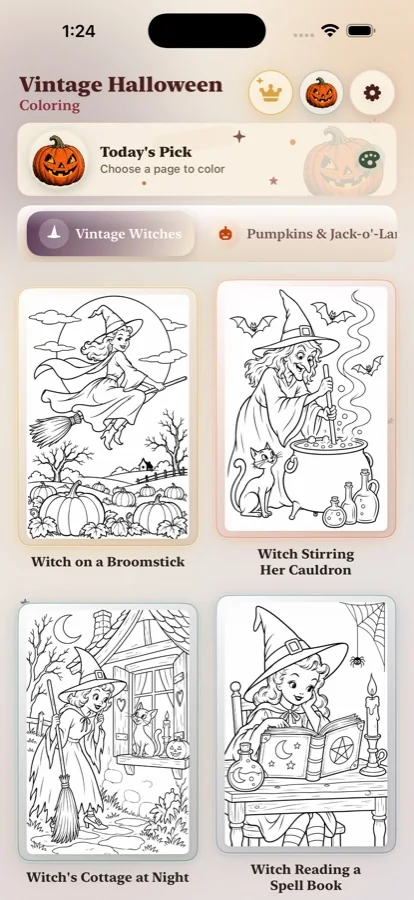
Explore nostalgic Halloween scenes and color one detail at a time in the iPhone app.