Gothic Halloween coloring pages for adults sit at the meeting point of seasonal mystery and dark romantic art. Think an old stone arch, a black cat on a moonlit fence, a candle beside dried flowers, a crooked roof against a large moon, or a witch’s familiar in a quiet garden. The style can be elegant, curious, or a little eerie without becoming graphic horror. A few deliberate colors and one clear light source are often enough to make the page feel atmospheric.
There is a visible aesthetic signal behind this direction. A 2026 Halloween trend review adapting Pinterest’s “Vamp Romantic” forecast points to dark florals, vintage frames, ravens, moons, candles, and plum or burgundy palettes. Those underlying Pinterest searches were for beauty and fashion, not coloring pages, so they do not establish coloring-keyword volume; they do suggest a broader visual vocabulary that can carry into seasonal art. Recent colorists also ask for Halloween books beyond the very simple cozy style. See the 2026 Halloween trend review and a recent Halloween coloring-book discussion.
What makes a coloring page feel gothic?
Gothic is a visual language, not a requirement to color everything black. Look for a combination of silhouette, age, ornament, and light. The architecture might have pointed windows or a narrow stairway. Plants might include curling vines, roses, thorns, or bare branches. A candle, moon, or distant window gives the scene a small source of light. The design can be richly detailed yet still have a clear place for the eye to rest.
It helps to distinguish a few related moods:
- Gothic: arches, old buildings, wrought shapes, dramatic silhouettes, and a sense of history.
- Dark romantic: roses, velvet-like folds, antique frames, candlelight, and deep red or plum accents.
- Witchy or celestial: moons, stars, herbs, potion bottles, and symbolic objects.
- Horror: frightening or graphic imagery. This is one possible direction, not a requirement of gothic art.
A page can combine these moods, but choosing its main identity before coloring helps the palette stay coherent. For more mature Halloween styles across different moods, browse our guide to Halloween coloring pages for teens and adults.
Gothic motifs to look for in Halloween line art
Old houses and pointed architecture
Arches, narrow windows, rooflines, staircases, and ornamental doors create a strong structure. Decide whether the building is lit from within or mostly in silhouette. A few warm windows against a cool stone or night palette can tell the whole story.
Dark botanicals and moonlit branches
Roses, leaves, thorny stems, and bare branches add texture around the focal subject. Repeating one leaf color across the page can keep botanical detail from competing with the architecture. Use a lighter edge or a small highlight where a branch crosses the moonlit background.
Familiar animals and quiet symbols
A cat, bat, owl, or raven can make a page feel mysterious without adding horror. Let the animal read clearly against its setting: a charcoal silhouette over cream moonlight, or a warm-eyed cat against an indigo fence. Small stars, keys, books, and candles can support the scene.
Antique objects and candlelit rooms
Books, bottles, picture frames, old clocks, and candlesticks suggest a story even when the character is out of view. Choose one or two objects for the brightest highlights. If every glass bottle glows equally, the focal point disappears.
Build a gothic Halloween palette
Start with a dark neutral, a cool night color, a warm light, and one expressive accent. Then vary the value—the relative lightness or darkness—so the forms remain readable.
| Mood | Palette idea | Good for |
|---|---|---|
| Moonlit manor | Indigo, blue-gray, charcoal, cream, muted gold | Stone, night sky, pale moon, a few lit windows |
| Dark rose | Burgundy, plum, dusty rose, deep green, warm ivory | Botanical frames, roses, velvet-like clothing |
| Antique apothecary | Sepia, moss, brown-black, faded teal, candle yellow | Books, bottles, herbs, wood, brass details |
| Storybook witch | Violet, forest green, old gold, charcoal, pale lavender | Hats, cloaks, cats, moons, small magical accents |
Use black sparingly as the deepest value. A charcoal roof, indigo sky, and plum cloak still feel dark, but each remains distinct from the others. Reserve the lightest cream or yellow for the moon, a candle flame, or a window. That contrast guides the viewer through the page.
For broader pumpkin, midnight, and vintage combinations, explore our Halloween coloring palette guide. It helps when you want to keep a gothic image connected to familiar autumn colors.
A step-by-step example: a cat beneath a moonlit arch
Suppose your page shows a black cat sitting under an old stone arch with climbing roses and a crescent moon. Try this sequence:
- Choose the light source. Let the moon sit behind or above the arch. Keep a pale area around it so the silhouette stays clear.
- Separate the darks. Color the sky indigo, the cat charcoal, and the arch in blue-gray or muted stone. Avoid using one flat black across every surface.
- Give the roses one accent. Use burgundy or dusty rose for a few blooms, then repeat that color in a tiny detail such as a ribbon or book spine.
- Add a warm counterpoint. Place a muted gold highlight in one window, candle, or collar. One small warm point makes the moonlight feel cooler.
- Finish the edges last. Add a few leaf highlights and fine details after the large values are working. Stop when the scene reads clearly; every small space does not need a different color.
The same plan adapts to a witch on a broom, a haunted cottage, or a still life of books and bottles. Choose a focal subject, separate the large dark shapes, and let only a few accents sparkle.
Keep dark coloring detailed, not muddy
When a page contains many small areas, color one object or zone at a time. A limited palette helps you repeat colors with purpose. Before adding a second dark layer, ask whether it adds shape or simply makes the section darker. Preserve the printed outline and a few lighter areas so the image does not collapse into one mass.
Colored pencils allow gradual shading in stone, fabric, fur, and leaves. Begin with light pressure, build a second value near folds or edges, and use the lightest shade to soften a transition. For a detailed color workflow, see our colored-pencil guide.
Markers can provide strong, even blocks of color in larger areas. Test them on the exact paper, put a protective sheet beneath the page, and be careful around narrow outlines. Our instructions for coloring Halloween pages with alcohol markers cover swatches, blends, and bleed-through.
Choose a gothic scene that fits your mood
Not every gothic page needs to be intricate. A single black cat beneath a crescent moon can carry the style through silhouette and contrast. A detailed apothecary or overgrown manor invites a longer session. If you are comparing page types, read how to enjoy detailed Halloween coloring pages or explore the story structure in our guide to haunted-house Halloween coloring pages.
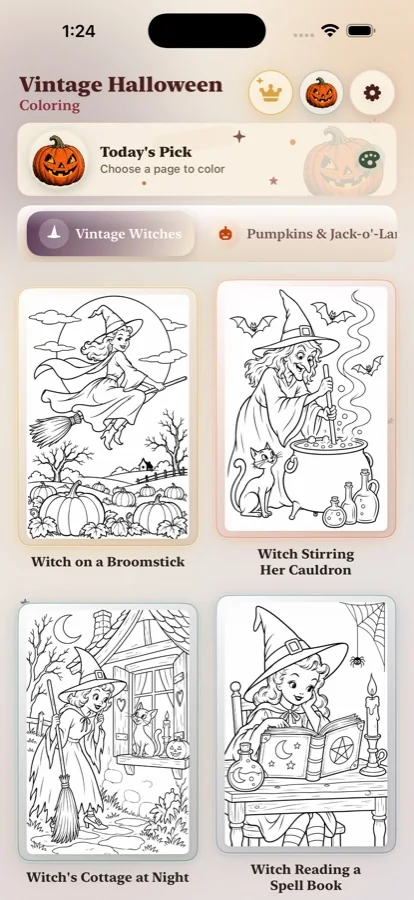
Vintage Halloween Coloring is an iPhone coloring book built around nostalgic witches, pumpkins, cats, and autumn scenes. Browse the Halloween coloring collection for adults or open the official App Store page to see the app.
Frequently asked questions
What are gothic Halloween coloring pages?
They use atmospheric motifs such as pointed architecture, old houses, candlelight, dark botanicals, moons, cats, and antique objects. They can be mysterious or romantic without relying on graphic horror.
What colors work for gothic Halloween coloring pages?
Try charcoal, indigo, plum, burgundy, muted green, warm cream, and antique gold. Use several related dark values instead of filling every shadow with flat black.
How do I keep a gothic coloring page atmospheric instead of too dark?
Choose a clear light source, reserve pale areas for moonlight or candles, and vary dark hues across stone, cloth, sky, and foliage. A few highlights help preserve the focal point.
Are gothic Halloween pages suitable if I do not like horror?
Yes. Choose architecture, botanical forms, vintage objects, moonlight, and elegant contrast, and skip motifs that feel too frightening for your taste.
Which tools work best for detailed gothic coloring pages?
Colored pencils work well for gradual shading and fine texture. Markers can make bold areas when the paper supports them; test first and protect the surface below. Digital coloring can make color changes and zooming easier.
Keep a dark romantic scene close.
Explore nostalgic Halloween art and color at your own pace in the iPhone app.