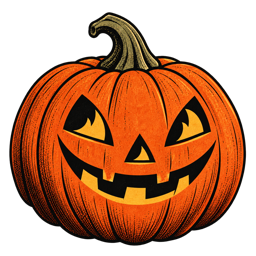
Few images say Halloween as quickly as a jack-o-lantern. Its round shape, crooked stem, carved eyes, and warm inner glow can be funny, friendly, mysterious, or genuinely spooky depending on the face and the colors. That flexibility makes Halloween pumpkin coloring pages useful for almost everyone: toddlers can fill a large pumpkin with broad crayon marks, children can design their own expression, and adults can spend an evening shading a detailed pumpkin patch under a moonlit sky.
Pumpkin pages also offer an easy path into creative choice. Orange is a natural beginning, but it is not a rule. A pumpkin can be cream, teal, burgundy, lavender, green, or a combination of several colors. The carved face can look happy, sleepy, surprised, mischievous, or completely imaginary.
What makes a good Halloween pumpkin coloring page?
A strong pumpkin coloring page gives the subject enough space to be recognized immediately. The sections of the pumpkin should be clear, the stem should be distinct, and the face should remain readable when colored. More detailed pages can add vines, leaves, porch steps, cats, ghosts, bats, or a distant cottage, but the pumpkin should still feel like the visual center.
Look for:
- Clear pumpkin sections: curved ribs help guide coloring and make shading feel natural.
- Readable expressions: the eyes and mouth should have enough open space for color.
- Different levels of detail: one pumpkin for a short session, a patch or scene for a longer project.
- Useful negative space: an open sky or background gives the colorist room to create atmosphere.
- Printable line art: strong contrast should survive ordinary home or classroom printing.
Our Halloween coloring pages collection includes pumpkin fields, witches, black cats, moonlit trees, and storybook scenes. Choose a page by the time and energy available rather than by how impressive it looks in a preview.
Simple pumpkin pages for young children
A single smiling pumpkin is a good first Halloween page. The child can color the large sections, add a face, and choose whether the pumpkin is sitting on grass, a porch, or a pile of leaves. Keep the prompt simple: “What kind of face should your pumpkin have?”
For toddlers and preschoolers, use broad outlines and large open areas. A child may color outside the lines, change colors halfway through, or cover the face with one enthusiastic shade. That is part of exploring the page. For more guidance, read Halloween coloring pages for preschoolers and toddlers.
Kindergarten learners can count the pumpkin sections, trace the word pumpkin, compare large and small pumpkins, or create a simple pattern with orange and green. Our guide to Halloween coloring worksheets for kindergarten includes more learning extensions.
Design your own jack-o-lantern face
The face is where a pumpkin becomes personal. Before coloring, ask the artist to sketch three possible expressions on scrap paper. One can be happy, one surprised, and one mysterious. Then choose the face that best matches the colors they want to use.
Try prompts such as:
- Draw a pumpkin that is laughing.
- Give the pumpkin sleepy eyes and a tiny smile.
- Create a face that looks surprised by a ghost.
- Make a pattern instead of a face.
- Design a pumpkin with stars, hearts, or crescent moons.
- Give the jack-o-lantern a hat, glasses, or a friendly companion.
This activity works on a printed page or in a digital app. It also makes a useful classroom or family game: everyone designs a face, then describes the feeling without showing the page.
How to color a glowing jack-o-lantern
To suggest light, use the brightest color inside the eyes and mouth. Cream, pale yellow, or warm white can create the center of the glow. Add orange around the carved openings, then deepen the outer ribs with rust, brown, or burgundy.
A cool background makes the warm face more convincing. Try midnight blue, dusty purple, charcoal, or deep teal behind the pumpkin. Add a few stars or a moon if the page has open sky. The contrast between warm light and cool shadow is more important than using a large number of colors.
For a softer effect, keep the pumpkin pale and use a golden accent only inside the face. For a dramatic effect, let the eyes and mouth be the brightest shapes on the entire page.
Traditional, vintage, and unexpected pumpkin palettes
Halloween pumpkin coloring pages are a perfect place to practice color families. Start with a palette that matches the mood:
- Classic jack-o-lantern: orange, yellow, black, green, and brown.
- Vintage harvest: rust, parchment, olive, burgundy, and faded teal.
- Moonlit porch: cream, burnt orange, navy, lavender, and charcoal.
- Cozy pumpkin patch: soft orange, golden yellow, moss green, cocoa, and warm white.
- Magic pumpkin: plum, teal, pale blue, gold, and deep purple.
For more palette combinations, read Halloween coloring book color palettes. You can also look at the pumpkin page as a palette test: color one rib in a light shade, one in a middle shade, and one in a dark shade before committing to the whole illustration.
Pumpkin patches and full Halloween scenes
A pumpkin patch gives older children, teens, and adults more to explore. The foreground pumpkins can be large and detailed, while smaller pumpkins become a way to suggest distance. Add leaves, vines, a fence, a scarecrow, or a distant house.
Choose one visual focus. Maybe the largest pumpkin is bright orange while the background is muted. Maybe a single jack-o-lantern glows near a dark fence. Maybe the entire field uses a vintage palette and the sky carries the strongest contrast.
Scenes do not need to be frightening. A pumpkin patch can feel calm, nostalgic, playful, or mysterious. For a gentle direction, explore cute Halloween coloring pages. For a more mature selection, see Halloween coloring pages for teens and adults.
Pumpkin coloring pages for classrooms and family activities
Pumpkins are ideal for a mixed group because every age understands the subject. A younger child can color a single pumpkin. An older child can create a scene. An adult can shade the ribs, leaves, and background with a limited palette.
Try a shared pumpkin project:
- Give everyone a different pumpkin page or the same outline.
- Choose one common color, such as orange, gold, or teal.
- Let each person add two personal colors.
- Display the finished pumpkins together as a patch.
The shared color creates a visual connection without making the pages identical. In a classroom, the pumpkins can become a wall display. At home, they can be cut out and arranged on a refrigerator or window.
For more group ideas, read Halloween coloring pages for the classroom and Halloween coloring pages crafts and decorations.
Use pumpkin pages for early learning
A pumpkin illustration can support more than color recognition. Ask children to count the ribs, compare the sizes, trace the stem, find the smallest leaf, or draw a line from the pumpkin to the basket. A page with several pumpkins can become a gentle counting and observation activity.
For vocabulary, introduce words such as stem, vine, rib, patch, leaf, seed, harvest, lantern, and glow. Use the words in conversation instead of turning them into a test. “Which pumpkin has the longest stem?” is a playful prompt that encourages careful looking.
Printable pumpkin coloring pages at home
Use a PDF or high-resolution image rather than a small screenshot when printing. Check whether the page is made for US Letter or A4, and select fit-to-page if the proportions differ. Print one test sheet to make sure the lines remain visible and the margins are comfortable.
Copy paper is fine for crayons and pencils. Cardstock is better if the colored pumpkin will become a card, garland, gift tag, or window decoration. Place scrap paper underneath markers and keep the page single-sided if you plan to display it.
For detailed advice, read our printable PDF guide. If you want to use the finished page as a craft, see our guide to Halloween coloring crafts.
Digital pumpkin coloring on iPhone and iPad
Digital coloring makes it easy to test pumpkin palettes before printing. Try a traditional orange pumpkin, save it, then create a moonlit blue version. Zoom into the face to add a small highlight. Undo a color that feels too strong and keep several versions of the same design.
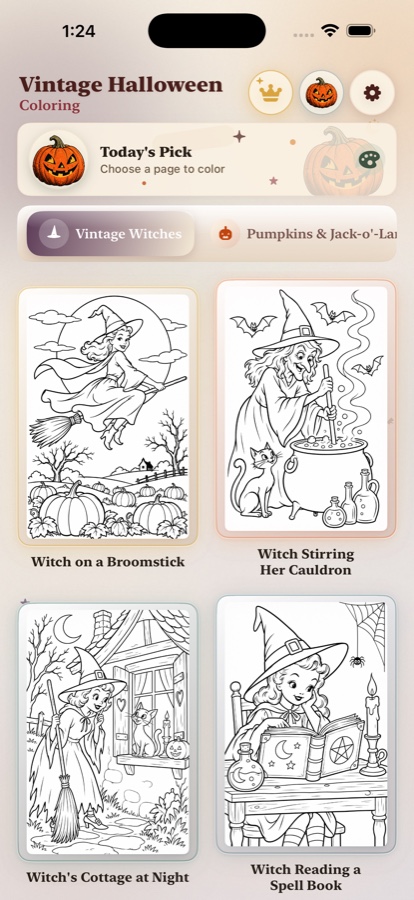
The Vintage Halloween Coloring iOS app offers nostalgic Halloween scenes for this kind of exploration. A pumpkin page can be a quick creative break or the beginning of a longer digital illustration. When you find a favorite palette, use it as inspiration for a paper page or a handmade decoration.
Turn pumpkin pages into decorations
A finished jack-o-lantern is already a decoration. Mount it on dark cardstock and place it on a table. Cut around the silhouette and string several pumpkins into a garland. Add a name and a message to make a gift tag. Use a row of different faces as a party sign.
For a family craft, have each person color one pumpkin in a different mood: cozy, funny, spooky, sleepy, or magical. Display them together with a small handwritten label. The result feels more personal than a store-bought decoration because every expression belongs to someone.
Choose a pumpkin page by mood
Search results often group pumpkin pages by subject, but mood can be a better way to choose. A simple smiling pumpkin is right for a quick beginning. A pumpkin with a cat or ghost adds story. A pumpkin patch creates a longer project. A carved face with a moon and bats feels more dramatic.
Ask three questions:
- How much time do I have?
- Who is coloring?
- Should the finished page feel cheerful, cozy, vintage, or spooky?
The answers usually point to the right level of detail. There is no benefit in choosing the most intricate page if the colorist wants a ten-minute break. A simple page can be the most satisfying choice when it fits the moment.
Final thoughts
Halloween pumpkin coloring pages are popular because the subject is familiar but never finished. Every face can change. Every palette creates a new mood. A single pumpkin can become a beginner page, a classroom prompt, a family craft, a vintage poster, or a quiet adult coloring ritual.
Start with the shape. Choose the face. Decide where the light comes from. Then let the pumpkin become whatever kind of Halloween you want to make today.
Frequently asked questions about Halloween pumpkin coloring pages
What are good Halloween pumpkin coloring pages for beginners?
Start with one large pumpkin or jack-o-lantern with bold outlines, open sections, and a simple face. These pages are easy to understand and leave plenty of room for color experiments.
How can I color a jack-o-lantern so it looks illuminated?
Use a bright yellow or cream inside the eyes and mouth, warm orange around the face, and darker rust or brown on the outer sections. A cool blue or purple background makes the glow stand out.
Are pumpkin coloring pages suitable for adults?
Yes. Adults can choose detailed pumpkin patches, moonlit scenes, vintage harvest illustrations, or patterned jack-o-lanterns and use layered autumn palettes.
Can colored pumpkin pages be used for Halloween crafts?
Yes. Finished pumpkin pages can become garlands, cards, gift tags, window decorations, table signs, bookmarks, and framed seasonal art.