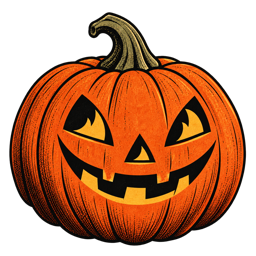
Not every Halloween coloring page needs to be an intricate project. Sometimes the best page is a simple pumpkin, a friendly ghost, a witch's hat, or a black cat beneath a moon. Easy Halloween coloring pages give you a clear place to begin, enough space to make confident choices, and a finished image you can enjoy without spending an entire evening on tiny details.
That makes simple coloring especially useful for beginners and adults who want a calmer creative activity. You can learn how different colors behave, practice shadows, and discover your own style without feeling that every mark has to be perfect. A page with bold line art is not a lesser version of a detailed illustration. It is an invitation to participate.
What makes a Halloween coloring page easy?
Difficulty is not only about the number of lines. A page feels easy when its visual decisions are clear. One main character, strong outlines, large areas, and a clean background make it easier to understand where to start. Familiar symbols help too: almost everyone knows what a pumpkin, moon, ghost, or witch hat should look like, so you can focus on color instead of decoding the image.
Look for these features when you choose a beginner-friendly Halloween coloring page:
- Bold outlines: clear lines are easier to follow with pencils, markers, crayons, or a digital brush.
- Open spaces: large shapes let you practice smooth fills, gradients, and simple shadows.
- One visual focal point: a central pumpkin, cat, ghost, or witch gives the page a natural starting place.
- Limited background detail: a few stars, leaves, or clouds add atmosphere without making the page feel crowded.
- Recognizable shapes: familiar Halloween objects make color choices intuitive and enjoyable.
Our Halloween coloring pages for adults collection includes vintage witches, pumpkin fields, black cats, haunted houses, and ghostly scenes. Start with the page whose main shape immediately catches your eye. Your first decision should feel like an invitation, not a test.
Five easy Halloween coloring pages to try first
1. A classic jack-o'-lantern
A pumpkin is one of the most forgiving subjects for a beginner. Its rounded sections naturally suggest light and shadow, and you do not need a realistic orange to make it work. Try one warm pumpkin color across the middle, a deeper rust shade at the sides, and a small cream or yellow accent in the face.
If you want a vintage feeling, leave part of the pumpkin pale and use charcoal around the stem and ground. If you want something cheerful, give each section a slightly different orange. The same simple outline can become cozy, theatrical, or playful depending on the palette.
2. A friendly ghost
Ghosts give you permission to use the paper or screen as part of the color. Instead of filling the whole shape with white, add a cool gray, dusty lavender, or pale blue shadow along the lower edge. Keep the face simple and let the background provide the stronger color.
A warm cream background with a muted orange moon makes a ghost feel like an old Halloween postcard. A midnight blue sky and one gold star creates a quieter, more atmospheric page.
3. A witch hat and broom
A hat is an excellent first page because it combines broad areas with a few small accents. Use plum or charcoal for the cone, a warm gold buckle, and muted moss or brown for the broom. You can practice a gentle highlight along one side without needing to shade an entire character.
Once the main shapes are colored, add a simple ground shadow or a few stars. Two or three small details are enough to make an easy page feel complete.
4. A black cat beneath the moon
Black cats are ideal for learning that “black” does not have to mean one flat color. Try charcoal, deep plum, midnight blue, or a soft brown-black. Leave a narrow highlight along the back or face so the silhouette remains expressive.
Use the moon as the brightest part of the composition. A pale cream circle behind the cat can do more for the page than a complicated background, and it gives you an easy lesson in contrast.
5. A small haunted cottage
A cottage looks complicated at first, but you can simplify it into a few visual groups: roof, walls, windows, path, and sky. Choose one warm color for the windows, one dark color for the roof, and a restrained landscape palette for everything else.
Do not feel pressure to color every brick or leaf. Leaving some areas light creates depth and keeps the page comfortable. The empty space is part of the design.
Easy does not mean childish
Many people search for cute or easy Halloween coloring pages because they want a friendly entry point, not because they want artwork that feels young. A mature simple page can have a thoughtful composition, a restrained palette, and a nostalgic subject while keeping the outlines approachable.
The difference is often in the details around the main object. A single pumpkin can feel sophisticated when it sits beside a candle, an old book, or a bare branch. A friendly ghost can feel atmospheric when the background uses quiet negative space. A witch can feel elegant when the silhouette and palette do more work than a crowded pattern.
Vintage Halloween art is particularly good at this balance. It relies on expressive shapes and a strong mood rather than filling every inch. Read why vintage Halloween art still feels modern if you want to understand how limited palettes and clear silhouettes create visual character.
How to color a simple page without making it flat
Simple coloring pages are a good place to learn a few techniques that create depth without adding visual clutter. You only need a small number of changes to make a large shape feel dimensional.
- Choose a light source. Decide whether the light comes from the moon, a candle, a window, or the front of the page.
- Use two shades of one color. Keep the base color broad, then add a darker version near edges, folds, or the ground.
- Reserve one bright accent. A yellow window, gold buckle, or pale moon gives the eye somewhere to land.
- Repeat one color. Use the same rust, plum, or moss in three small places so the page feels connected.
- Leave room uncolored. Light areas create contrast and keep the final image from feeling heavy.
Our guide to Halloween coloring book color palettes has more ideas for pumpkin, midnight, and vintage tones. For a first page, three main colors and one accent are usually enough.
Printable or digital: which is easier for a beginner?
Printable Halloween coloring pages are a satisfying choice when you already have pencils or markers nearby. Print one page at a time rather than making a large stack. That keeps the activity focused and lets you choose a paper weight that matches your tools.
Digital coloring is beginner-friendly for a different reason: mistakes are reversible. You can test a color, undo it, zoom into a small area, and try a different palette without starting over. A digital collection is also convenient when you want to color on an iPhone or iPad without preparing a table.
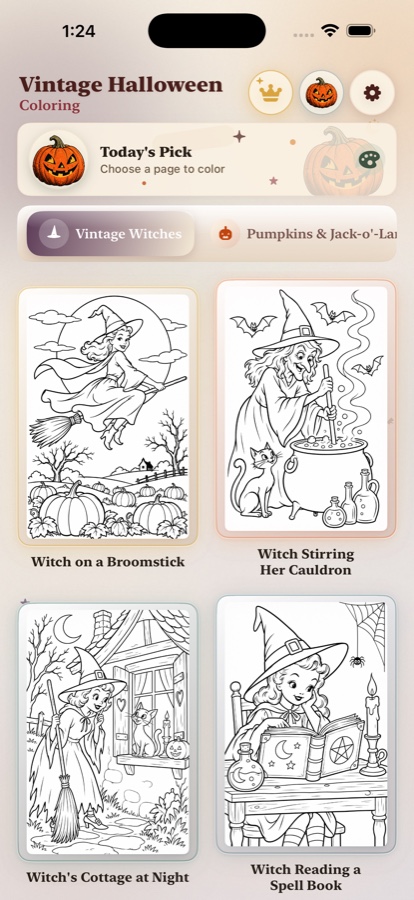
The Vintage Halloween Coloring iOS app is built around that low-pressure experience. Choose a page, experiment with a color preset, and keep going only as long as the session feels enjoyable. There is no need to finish a complicated scene to have a successful coloring break.
A gentle path from easy to detailed pages
You do not have to choose between only “easy” and “hard.” Think of coloring as a gradual path. Start with a single object, then choose a page with two or three objects, and finally move into a full scene with a foreground, middle distance, and background.
For example, begin with a pumpkin. Next, try a pumpkin patch with leaves. After that, choose a witch flying over a field or a cottage beneath the moon. Each step adds a little more decision-making while keeping familiar shapes in view.
Pay attention to what feels satisfying. Some people enjoy filling broad areas and prefer bold, easy coloring books long-term. Others like starting simply and gradually looking for more intricate illustrations. There is no correct destination. The best page is the one that fits your attention today.
Make your first Halloween coloring session easy
Set yourself up so the first five minutes have almost no friction. Choose one page, place three colors nearby, and decide that you only need to color one shape. A small beginning is more useful than a perfect plan.
If you are coloring in the evening, use warm light and silence notifications. If you are printing, test the page once at full size so the outlines are clear. If you are coloring digitally, start with a preset rather than an empty palette. These small choices protect the relaxing part of the activity.
Our article on Halloween coloring for stress relief explains how to turn a short session into a repeatable autumn ritual. You can also read how to choose the best Halloween coloring book for adults when you want to compare styles, formats, and levels of detail.
Start with the page that feels welcoming
Easy Halloween coloring pages are not a compromise. They are a way to enter the season with less pressure and more choice. A bold pumpkin, a soft ghost, a crooked hat, or a single moon can carry an entire mood when the lines are clear and the colors are yours.
Begin with one familiar subject. Use a small palette. Let some areas remain light. Then stop whenever the page feels complete to you, even if the page is not technically finished. That is the quiet advantage of simple coloring: it leaves enough room for the person coloring it.
Frequently asked questions about easy Halloween coloring
What are the easiest Halloween coloring pages for beginners?
Start with clear bold outlines, large open shapes, and one main subject such as a pumpkin, ghost, witch hat, black cat, moon, or simple haunted house.
Are easy Halloween coloring pages only for kids?
No. Easy pages are excellent for adults who want a short, relaxing, low-pressure session or who prefer expressive color choices over tiny details.
How do I make a simple Halloween coloring page look more detailed?
Add depth with two shades of one color, simple cast shadows, a limited background pattern, and one repeated accent color instead of filling every area with intense detail.
Is digital coloring good for beginners?
Yes. Digital coloring lets you undo choices, test palettes, zoom into details, and start immediately without printing or organizing supplies.